
Captain Blood - Book Report
- Jul 29, 2025
- 11 min read
Updated: Jul 30, 2025
August 2025

PAGE ONE
CAPTAIN BLOOD
His Odyssey
by Rafael Sabatini
Chapter I
The Messenger
“PETER BLOOD, bachelor of medicine and several other things besides, smoked a pipe and tended the geraniums boxed on the sill of his window above Water Lane in the town of Bridgewater.
Sternly disapproving eyes considered him from a window opposite, but went disregarded. Mr. Blood’s attention was divided between his task and the stream of humanity in the narrow street below; a stream which poured for the second time that day towards Castle Field, where earlier in the afternoon, Ferguson, the Duke’s chaplain, had preached a sermon containing more treason than divinity.
These straggling, excited groups were mainly composed of men with green boughs in their hats and the most ludicrous of weapons in their hands. Some, it is true, shouldered fowling pieces, and here and there a sword was brandished; but more of them were armed with clubs, and most of them trailed the mammoth pikes fashioned out of scythes, as formidable to the eye as they were clumsy to the hand. There were weavers, brewers, carpenters, smiths, masons, bricklayers, cobblers, and representatives of every other of the trades of peace among these improvised men of war. Bridgewater, like Taunton, had yielded so generously of its manhood to the service of the bastard Duke that for any to abstain whose age and strength admitted of his bearing arms was to brand himself a coward or a papist.

Yet Peter Blood, who was not only able to bear arms, but trained and skilled in their use, who was certainly no coward, and a papist only when it suited him, tended his geraniums and smoked his pipe on that warm July evening as indifferently as if nothing were afoot. One other thing he did. He flung after those war-fevered enthusiasts a line of Horace — a poet for whose work he had early conceived an inordinate affection:
“Quo, quo, scelesti, ruitis?” [Where, where are you wicked ones rushing?]”
A hot-blooded, cool-headed patriotic doctor who tosses off Latin phrases whilst tending to the boxed geraniums on his window sill?

Yes, I’ll have one of those Doctors, any day, any time of the day, or night, for any malady, flu, ague or even a bad case of gout!
In the fictional paladin of Dr. Peter Blood, Rafael Sabatini (1875–1950) came upon — whether through stumbling, or stepping carefully, or striding audaciously — a character for the ages, a swashbuckling hero that only Hollywood of the Golden Era could adequately put into celluloid action. Sabatini himself never lost his touch for putting even more gallant touches on Peter Blood.
The character Captain Blood was initially invented by Sabatini in a series of eight short stories that were published from December 1920 to March 1921 in Premier Magazine. These “Tales of the Brethren of the Main” were thereafter reprinted in Adventure Magazine from January — May 1921. Blood takes on more flesh as a fictional hero in the novella Captain Blood’s Dilemma, which was published in Premier Magazine in April 1921.

The story arc of these works takes on the form of Homer’s Odyssey, evolving and being woven by Sabatini into the novel form that was published in 1922 as Captain Blood: His Odyssey. Dr. Peter Blood returns in the 1931 set of short stories entitled Captain Blood Returns (which was retitled The Chronicles of Captain Blood in the British publication).
Sabatini believed strongly in basing historical fiction as closely as possible on the actual history. It worked spectacularly for him with the crafting of Captain Blood.

Dr. Peter Blood is the conscientious and bold Irish physician who commits treason through performing the art of healing upon a rebel wounded in the Battle of Sedgemoor at Westonzoyland in Somerset. This last and decisive engagement was fought on 6 July 1685 between the forces loyal to James II and the rebels, led by James Scott, the Duke of Monmouth (ergo the Monmouth Rebellion) to seize the crown of England from his uncle, the Catholic King James II.
The victorious Royalists lost approximately 100 men. The rebels lost more than 1600 men, which put an end to their army of rebellion. The Duke of Monmouth was captured and then executed. The captured rebels would become rebel-convicts and receive, during the Bloody Assizes (or trials held that August), the barbaric sentences of ten years of hard labor in Barbados.

The inhumanities of this chattel slavery, along with the political upheavals of the Glorious Revolution of 1688 in England, became the plot devices to grant Dr. Blood a broad enough pathway toward redemption. That journey, or odyssey, leads to the credible romantic ending of the Hollywood film Captain Blood. This movie was made on the back lot of Warner Brothers and at the California coast, but the story locales are Port Royal, situated at the mouth of the Kingston Harbour in southeastern Jamaica, along with other piracy realms in the Caribbean.
The historic creation of this fictional character by Sabatini dovetailed impeccably, perhaps fatefully, with the historic creation of Captain Blood, the film, in 1935, by Warner Brothers. Several leading male actors were considered for the role, but none came through as available or quite right. The studio, run with a tightwad but, at times, adventurous iron fist by Jack Warner, decided to take a chance on a virtual unknown actor named Errol Flynn. He came cheap, as did his leading lady, another thespian neophyte, Olivia de Havilland.
Screen magic cannot be planned. Magic, anywhere, is, in fact, impossible to arrange, plot, concoct, hatch, schedule, purchase, extort or demand. It just happens.

In this case, it’s as if the novel Captain Blood awaited its ultimate realization as the stuff of which movie legends, stars, and destinies are made. The direct, daring, and oftentimes cheeky writing style of Sabatini inspirationally set the bar very high for the excellence achieved by:
the superior acting by all professionals involved, newbie, oldie, major, minor; the detailed work by technicians in special effects, stunts, and set design; the skillful direction by fencing master Fred Cavens; the art direction by Anton Grot; the screenplay by Casey Robinson, the always-splendid and innovative direction by Michael Curtiz, the cinematography by Ernest Haller and Hal Mohr, the costume design by Milo Anderson, and the musical adaptation/arrangement by Erich Wolfgang Korngold of the Fugal Episode from Prometheus, composed in 1850 by Franz Liszt.

Having watched this film many times (perhaps a dozen) before I read the book CAPTAIN BLOOD this past summer, I believed I’d have to try mightily to block out the triumphant strains of the musical score. I soon discovered, however, from that first page of scintillating narration, that the engaging and fascinating writing style — the verbal swordplay — of Rafael Sabatini completely eliminated from my mind any reminders of the movie music.
The daring, dashing, astute doctor named Peter Blood, who embodied Errol Flynn, or perhaps it was the other way around, does not begin life, from Page One, as the idealistically bold Captain Blood of Warner Brothers celluloid fiction. The literary Dr. Blood is much closer to the real Errol Flynn: aloof, erudite, discerning, witty, cryptic, passionate, brilliantly deceptive, fearful of loving, even more fearful of being loved.

Talk about the mysteries of Fate!
I highly doubt that the Suits at WB, especially Hal Wallis, or even the aspiring novelist Flynn, made the eerie connections between Sabatini fiction and Errol Leslie Thomson Flynn fact. In 1935, Flynn the Irishman, er, the Australian, er, the Tasmanian, was as much fiction as fact.
In this extraordinary confluence of the Fates, it wasn’t a matter of Hollywood vs. History but Hollywood co-opting Reality. The righteous indignation that typified, and drove, the performance of every luminous, swashbuckling Errol Flynn character was palpably real.
To continue the citation from that First Page:
“And now perhaps you guess why the hot intrepid blood inherited from his Somersetshire mother remained cool amidst all of this frenzied fanatical heat of rebellion; why the turbulent spirit which had forced him once from the sedate academical bonds his father would have imposed upon him, should now remain quiet in the very midst of turbulence. You realize how he regarded these men who were rallying to the banners of liberty — the banners woven by the virgins of Taunton, the girls from the seminaries of Miss Blake, and Mrs. Musgrave, who — as the ballad runs — had ripped open their silk petticoats to make colors for King Monmouth’s Army. That Latin line, contemptuously flung after them, as they clattered down the cobbled street, reveals his mind. To him they were fools rushing in wicked frenzy upon their ruin.”

The forces of innocence, hope and liberty do battle against corruption, greed and tyranny: this classic battle within humanity persists to this day. Dr. Peter Blood is initially indifferent, perhaps hostile, to all that the rebels stand for. He is proud of his self-sufficiency, and lack of need of anyone. The young and fiery Peter Blood is a rugged individualist who prefers the solitary life. He eyes, and sizes up, the wounded rebel, Lord Gildoy, whom he, as Medicinae baccalaureus, must treat.
“He deplored that a youth with such bright hopes in life as Lord Gildoy’s should have risked all, perhaps existence itself, to forward the ambition of a worthless adventurer . . .”

Dr. Peter Blood is thereafter led to imprisonment for having exercised his art upon a rebel, and for having believed:
“Why, what’s to fear? It’s a Christian country, this, and Christian men do not make war upon the wounded, nor upon those who harbour him.”
As Author Sabatini explains: “He still had, you see, illusions about Christians.”
The belief that the English would not enslave the Irish was a costly illusion. Dr. Blood also harboured a cocky naïveté about the price to be paid for being a Non-Conformist; and a bit too much wit and outspoken audacity in the face of power-hungry, blood-thirsty, sadistic Englishmen in thrall to King James II.

This monarch had many issues, in many senses of that word. King James II is a far cry from his predecessor, King James I, who authorized the King James Bible. The three-year reign of terror by King James II led directly to the Glorious Revolution of 1688. That revolution was both glorious and inglorious, but I’m getting ahead of royal English history (a topic which confuses me as all get-out.)
Dr. Blood thence undergoes his crucible, the trials by fire that kick off his odyssey of illumination, repentance and redemption. His tormented travels and travails do not make of him a martyr, but a man of profound remorse. He eventually seizes the gentle but enduring swords of compassion, forgiveness, and yielding to the heart of another, but not by himself. He must first surrender his heart to the tender heart of the woman who is the niece of his tormentor, Arabella Bishop. Life, and love, teach this physician more, much more, with undeniable certainty, than any book could have done.

All other major characters in this book are keyed to react/respond to the sullen, scornful, sometimes sneering Dr. Peter Blood. Arabella Bishop, the love interest, receives the Hollywood makeover during the production of this surprisingly successful film of 1935. The Book Arabella has a heftier load to bear than does the Movie Arabella in transforming the heart of her reluctant beloved, through the catalyst of a noble, enduring love.
The scintillating dialogue, as well as prose, by Sabatini faithfully emerge throughout the dialogue of the screenplay, not always in the same order, but with equal purpose and sublime effect. We are dealing here with a master wordsmith, a man to whom success came late, after having plugged away at fiction for almost 25 years, before Scaramouche became an international best-seller (and future Hollywood film).

This novelist’s powerful language was splendidly transferred from fine literature into a compelling screenplay that ensured truly fine cinematic art. The “spirit of scorn” expressed verbally by Dr. Peter Blood is the major driver of his flight into piracy, and a proud piracy it is. The swashbuckling buccaneer, with a savagely wounded conscience, a potent lust for revenge, and an equally potent need for redemption — it’s a character type that never gets old.
The odyssey of Peter Blood, had it been presented in film, in the precise sequencing and wording that were so masterfully woven in the novel, would have been a long, boring slog that very well might have bombed at the box office — something the Warner Brothers did not easily abide.
Jack Warner knew a good story when he saw one that could be re-worked, re-constructed, or, if necessary, completely re-made into a screenplay. Peter Blood, doctor-turned-buccaneer, is the type of heroic, but flawed, character that Americans needed to see in action in 1935. We still need that redemptive intrepid mere mortal today, wherever, he, or she, might be.

In 1935, the winds of war were inexorably sweeping throughout Europe, generated by the murderous bully named Adolf Hitler. Herr Hitler and his Nazi Germany offered ominous proof the Germans had learned little, if anything, from their evils of the Great War. The future Supreme Commander of the Allied Expeditionary Force in Europe, Dwight D. Eisenhower, was quoted as having said, at the beginning of World War II, that Germany will have to be taken apart, and dismembered so that nation will not ever contemplate world conquest again.
After the bloody war in Europe finally ended with the surrender of Nazi Germany in 1945, General Eisenhower recommended the following:
“Get it all on record now – get the films – get the witnesses – because somewhere down the track of history some bastard will get up and say that this never happened,”

Prescient, that one.
The era in which any film that has magnificently stood the test of time, cannot be eliminated from its accurate, historic assessment.
Peter Blood, quiet, defiant skeptic of illegitimate authority, is the type of warrior that the world still needs, and very much so, in our present dilemma of feckless fools, put in charge of once-great nations by the moneyed wanna-be kings of crass corruption and tinpot dictatorship
The following dialogue is spoken from the sardonic yet romantic depths of Mr. Flynn as he incarnates prisoner Blood, below deck in the sailing ship, bound from England to Port Royal:
It's a truly royal clemency we're granted, my friends . . .
One well worthy of King James,
He spares us the mercifully quick extinction of the hangman’s rope,
and gives us the slow death of slavery.

He grants us our lives in exchange for a living death. Faith, it’s an uncertain world entirely.
Rafael Sabatini excelled in granting lives to fictional heroes who would never die. As for the cinematic art imitating life in the 1935 studio factory-production of Captain Blood, one can only guess at the level of amazement felt during the viewings of those daily rushes of neophyte Flynn-on-film. Peter Blood on paper came to life through Peter Blood in footage.
Errol Flynn spoke from his battered heart and tormented soul to voice the promptings of the brave hearts of skillfully invented, make-believe heroes in his first films. Those phenomenal and incomparable roles made him famous, and even more ill-fated.

There is something enchanting, spell-binding, and otherworldly about his performance as Dr. Peter Blood/Captain Blood. It’s so much more than star appeal. It’s the innate aspiration of a young man to reach toward the stars.
Whenever I hear him thrillingly exhort:
“Aloft! There’s no chains to hold you now. Break out those sails and watch them fill with the wind that’s carrying us all to freedom!” —
I’m right there, with him!
Whenever I hear his dashing demand: “Alright, ma hearties! Follow me!” —
I’m following, with sword in hand!
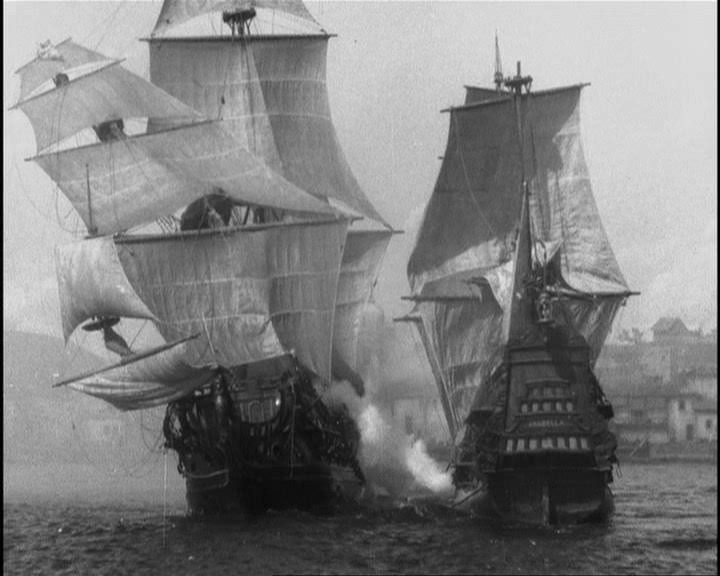
Errol Flynn was the peerless personification of the immortal character created by Rafael Sabatini: Dr. Peter Blood, Captain Blood, a man who loved liberty more than life. For it is true that without liberty, there is not life, merely existence.
We are, indeed, indebted to Rafael Sabatini for this glorious classic hero who, with romance, adventure, and magic, lives to this very day, in the 21st century.


