
Just One More Thing: Columbo
- Feb 1, 2020
- 8 min read
Updated: Oct 6, 2025
February 2020

I did not watch Columbo, or any of the NBC Mystery Movies when they were initially on the telly in the 1970s, or, more precisely, from 1971-1978. I did not watch much t.v. at all during that period of my life. Early adolescence through early adulthood took up most of my attention, which was focused on survival. I was on-the-run, and on-the-go. Lugging around a t.v. set was not part of my life style. It would have slowed me down.
I travelled light, very light. At times, I am stunned in recalling how unencumbered was my life, at least in material terms. My most basic essentials were two avocado green Amelia Earhart suitcases (the big one and the smaller one), along with the train case; my Cassell’s French dictionary; and a radio. Books I borrowed from the public lending library. Why burden myself with things?
I intensely dislike(d) The Rolling Stones, but I must avow that until I got married, I WAS a rolling stone. And right up until this very day, I still keep that part of my self well-tended and well-rehearsed. You never know when you’ll need to face upheaval . . . again.

Upheaval was the spoken and unspoken theme of societal TV in the 1970s. The hour-plus-long programs included performers and plots from what used to be Hollywood movies; indeed, studio film sets and locations were routinely used. And although I did not partake in those televisual feasts, I did keep very close track of the names of the actors and the actresses. along with the show titles so that I could successfully, incredibly successfully, do the Weekly TV Guide Crossword Puzzle. Success breeds success!
I also learned a lot of the facts and factoids about these television programs in the Work World at, yes, the water cooler:
Columbo, MacMillan and Wife, McCloud, The 6 Million Dollar Man, Baretta, The Rockford Files, Charlie’s Angels, and even this sad statement about the 1970s, Happy Days.
I also kept a fashion-conscious eye on the hair styles and outfits from popular television shows that were splashed on a monthly, if not weekly, basis, all over U.S. magazine covers.
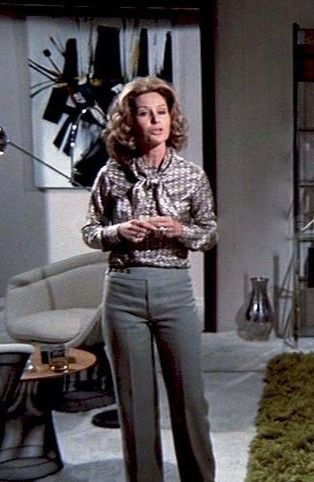
In particular, I tried to mimic the fashion of the “older women” in those tv series, as I ventured to look older and get better, higher-paying jobs. The results were comedic. The styles for American women of the 1970s expressed a rather sophisticated woman-of-the-world vibe, largely fabricated in polyester. Unfailingly, I looked like I’d just borrowed some outfits that did not suit me from Big Sister. My studious attempts to look older only made me look younger, and those authoritative jobs never went to me, the Command Decision-Maker. I suggested to one male co-worker that maybe I ought to try wearing fake glasses, the kind with just glass.
“NO!” He patiently explained to me the effect would be the reverse of what I was going for. Nowadays, whenever I see the nerdy-sexy-secretary-with-glasses look, I understand exactly what he meant. I didn’t, decades ago!
Dress-for-Success has been replaced by Dress-for-the-Job-You-Want. I guess I was doing too much of the latter when the former was en vogue. And now I dress for the jobs I never got!

I just did not “fit into” the 1970s, and, in many ways, neither did Lieutenant Colombo. He was the outsider, the oddity, the only guy who knew the score, the only one who really understood what was going on. He therefore did not let other people know much, or even a little, of his knowledge.
It’s a very effective ploy, especially whenever you’re around Know-It-Alls, the Holier-Than-Thous, and the Pompous Elite/Expert with the I-Don’t-Have-Time-For-You-the-Peon sneer.
I therefore come to this review of Columbo with a complete dearth of the original experience of that dramatic series, but with plenty of similar experiences of my own. My first encounter with Lieutenant Columbo was in the reincarnation ABC Mystery Movie from the 1990s, specifically 1989-2003, which occurred more than a decade after the end of its original run. I did, in fact, glean some details from the Columbo sleuthing stratagem whilst formulating the detective in my first novel, NORTHSTAR.
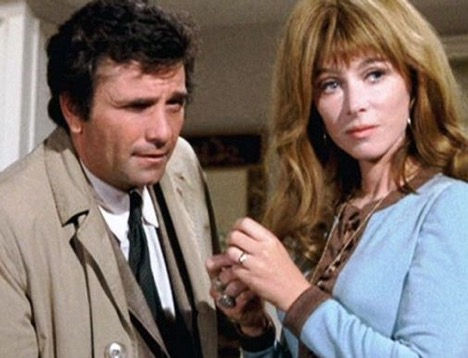
I’ve recently watched the first 4 episodes of Season One. This show is about as 1970s Southern California as you can get. The clothes, the hairstyles, the accessories, the furniture, the music, the shag rug, the appalling cars, the L.A. high-society life style — all unmistakably California Kulture of that epoch. Which is what makes Lieutenant Columbo stick out like a terrific sore thumb. I identify so well with the guy!
Peter Falk would become synonymous with this character. His acting ability was unique and utterly effortless by this time in his career. In terms of originality and breaking-the-mold within its formation, the Columbo character is right up there with Hercule Poirot and Sherlock Holmes, albeit in the lackadaisical, rumpled Southern California style of the pre-1970s.
Falk’s Columbo is a throwback to the late 1950s/early 1960s. He’s a film-noir figure in the bright lights of So-Cal, wherein the gumshoe wears a trench coat even though it never rains! The ironic contradictions are almost jarring.

Columbo offered the How-Catch-Em, as opposed to the traditional Who-Done-It. The laid-back acting style of Falk flowed seamlessly into the hyper-relaxed sensibility of this type of plot. The audience already knew the identity of the Killer. In a yawning, daydreaming sort of faux-non-strategy, Lt. Columbo drowsily fretted over whether he could finger the murderer. He knew quite well, however, that when the moment came for the Columbo-cat to pounce upon the guilty, often deviant, mouse, the claws would be sharpened to their finest point!
The character of Columbo was created by the dynamic writing team of Richard Levinson and William Link. It was Peter Falk, nonetheless, who created the flesh-and-bones of that inimitable character from that whole-cloth of the trench coat, along with the junker car (the Peugeot 403 Cabriolet); the well-travelled cigar, always in need of a match; and, later on, the basset hound.
Falk, in fact, used his own clothes and single-mindedly developed the idiosyncrasies that became the stock-in-trade of this seemingly bumbling detective who never fumbles the case. The ad-libs are all his, and the viewer very quickly begins to feel very much at home with this very human character.
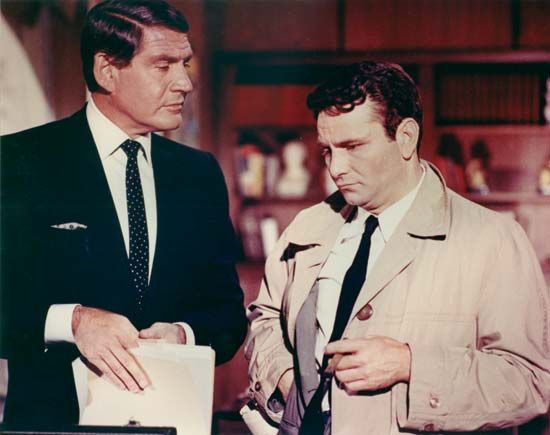
The first episode of Season 1 is rough. Columbo is nearly nasty in his hard-edged approach toward the killer, a shrink so smooth that a leisure suit glides right onto him. But this killer, played by Gene Barry, is debonair, well-mannered, and GQ-dressed. He’s a precursor of the cookie-cutter Politico of Modernity, preened to perfection by a Consultant Class that lacks class, conscience, decency, civility, everything except the cash fueled by the protection payola of the blackmail tactics that pass for a political party in the USA, and elsewhere.
By Episode Two, Colombo has softened, considerably. The killer is a woman, portrayed by the coldly attractive Lee Grant. Peter Falk is up against an actress of considerable heft, and scene-stealing savvy. His on-screen investigative plan-of-attack becomes a lot more subtle.

Episode Three complicates the plot with a weirdly slick and sick killer, played by Jack Cassidy. I found this dramatic sketch disturbingly realistic, perhaps because it was an early Steven Spielberg directorial show-off assignment. Episode Four features Robert Culp at his most almost-about-to-go-out-of-control; Patricia Crowley with beauty, elegance and sass; and a nearly bald Ray Milland, the dramatic Hollywood movie star who makes this small screen look big. Peter Falk gets to portray a very gentle side of the Columbo character.
By this fourth episode, the Columbo role has begun to take on fuller shapes and contours, working toward an almost complete embodiment of what would become an unforgettable character. The writers knew they had a smash hit, an immediate hit, on their hands. The titles of the episodes were superbly coined, as warrants a winner on the telly. Even more telling attention now gets paid to the already crisp dialogue, as well as to the filming locations.

The writers must have enjoyed drawing a jolting contrast between the schmoozy amoral jet-setters of that era,the 1970s, and the down-to-earth, ethical, blue-collar detective Columbo, a guy who eats at beaneries and hot dog stands. He’s not a slob, but sartorial excellence is not high on his list, even if he can find the list!
Lt. Columbo is, however, the palpable essence of a true-gentlemen of the working class. His etiquette, like his sense of decency, is innate. Manner, along with any morals, got tossed in the aqueduct by the Beverly Hills crowd on their way to the Rodeo Drive of the Beautiful People of Southern California.
The So-Cal snobs have, however, learned to fake politesse. They truly did lead the California Way on the very fraudulent veneer of being phony whilst pontificating to the working-class rubes about how they should live, think, eat, breathe, and choose Hip Entertainment. It is, in fact, their toxic hypocrisy of crooked-to-the-core vs. their snake-oil smooth and silky civility that often tips off the Lieutenant to To Identity of the Real Murderer. He sees just a glimpse of the real, hideous face behind the glossy, glitzy mask of pseudo and practiced propriety. He then quietly sets about going for the jugular of the murderous mountebank!

Peter Falk accepted this television role with the idea that it was a rotating “wheel” show, and would not require the shooting schedule of a full-series. A lack of desire for a commitment to a long-term, demanding television project might have been his original motivation. He wanted to still have time for his film career.
Falk then took the character of Lt. Columbo and he worked on it, or it worked on him, and they ran with this fictional creature, all the way to 4 Emmys! Falk’s methodical and meticulous understanding of the detective, Lieutenant Columbo, garnered him professional acclaim in Seasons 1, 4, 5, and then for a rebooted series from 1990.
Peter Falk had been a movie actor of modest achievement before he “became” Columbo. Once this role came to define him, this actor yielded to a career on the “small” screen, at a propitious time. The “big” screen, by the dawn of the 1980s, had shrunk considerably for any thespian in love with his craft. Whether or not Falk ever felt trapped by his living, breathing invention is perhaps immaterial. He formulated a fictional persona which broke the mold. In that sense, he owned Columbo, and not the other way around.

This mystery presentation also placed a definite serious emphasis on the musical score of each episode, which can be LOUD, unlike the Mystery Movie Theme that was composed by Henry Mancini. This quintessential-Mancini composition (beautifully melodic, with the Telltale Sound Effect) was also used to introduce the two other original “wheel shows”: McCloud and MacMillan and Wife.
The ABC Mystery Movie of a decade later was my first introduction to Peter Falk and his peerless character, Detective Columbo. There were 24 of them, from 1989-2003. Lt. Columbo didn’t fit into the partying 1970s, and he certainly did not fit into the 1990’s post-Cold War hedonism. And neither did I!

I watched many of these tv-mystery movies, but my favorite is “Murder, A Self-Portrait.”
This made-for-tv-movie features tremendously gifted thespians: Patrick Bauchau, Fionnula Flanagan, Vito Scotti, and Shera Danese (Falk’s wife). The sets are no longer 1970s California. We instead have late-1980s/1990s California!
The beach house was always a facet in Columbo World. The 1970s ones were dumps; these newer beach houses were worthy of cinema. There are very compelling Dream Sequences woven into the story-telling that add a complex dimension to an otherwise very straight-forward plot. The stellar acting is aided by very punchy dialogue.

The TV-screen of the 1970s offered up a lot of performances that made use of the movie sets of the defunct studios of the Golden Era of Hollywood. Outdoor shots were, by and large, on the streets of L.A., and on the beach, sometimes out in the desert, in the Hollywood Hills, or in a typical Studio Movie Ranch location. It is amazing and, at times, amazingly sad, to watch the sights and scenes of a much-less-densely populated Southern California that no longer exists.
The producers and directors of these shows busily created characters and scripts that either made it, or didn’t. If the show took off, spin-offs were probable. And so on and so on and so on. The concept of the Prequel, drafting off of any, and all, previous Success, had not yet emerged to threaten any — and all — prior plot lines and characters. For Hollywood, back then, there was always the possibility of re-makes in the future. For Hollywood now, well, there is no Hollywood now, anymore.


