
Resurfacing
- Oct 4, 2025
- 3 min read
Updated: Oct 4, 2025
4 October 2025

I am currently resurfacing, not as in re-finishing a surface, but in coming to the surface.
The past six days in my neck of the woods in Placer County were a blur of warm wet drizzly La Niña weather:
Soggy-feeling, musty-smelling, allergy-induced conditions that put me into overdrive creatively. I decorated for Halloween/Thanksgiving!
Come the First of November, I’m heading straight into Christmas mode.
The way I look at it, I’ve missed at least five Autumn/Winter Holiday Seasons in the United States. We Americans are not only saying “Christmas Again” — we’re saying a lot of other Banned Words and Thought-Policed Phrases.
Of course, I’ve been way ahead of that curve. I prefer to be ahead of the curve, instead of being clobbered by it.

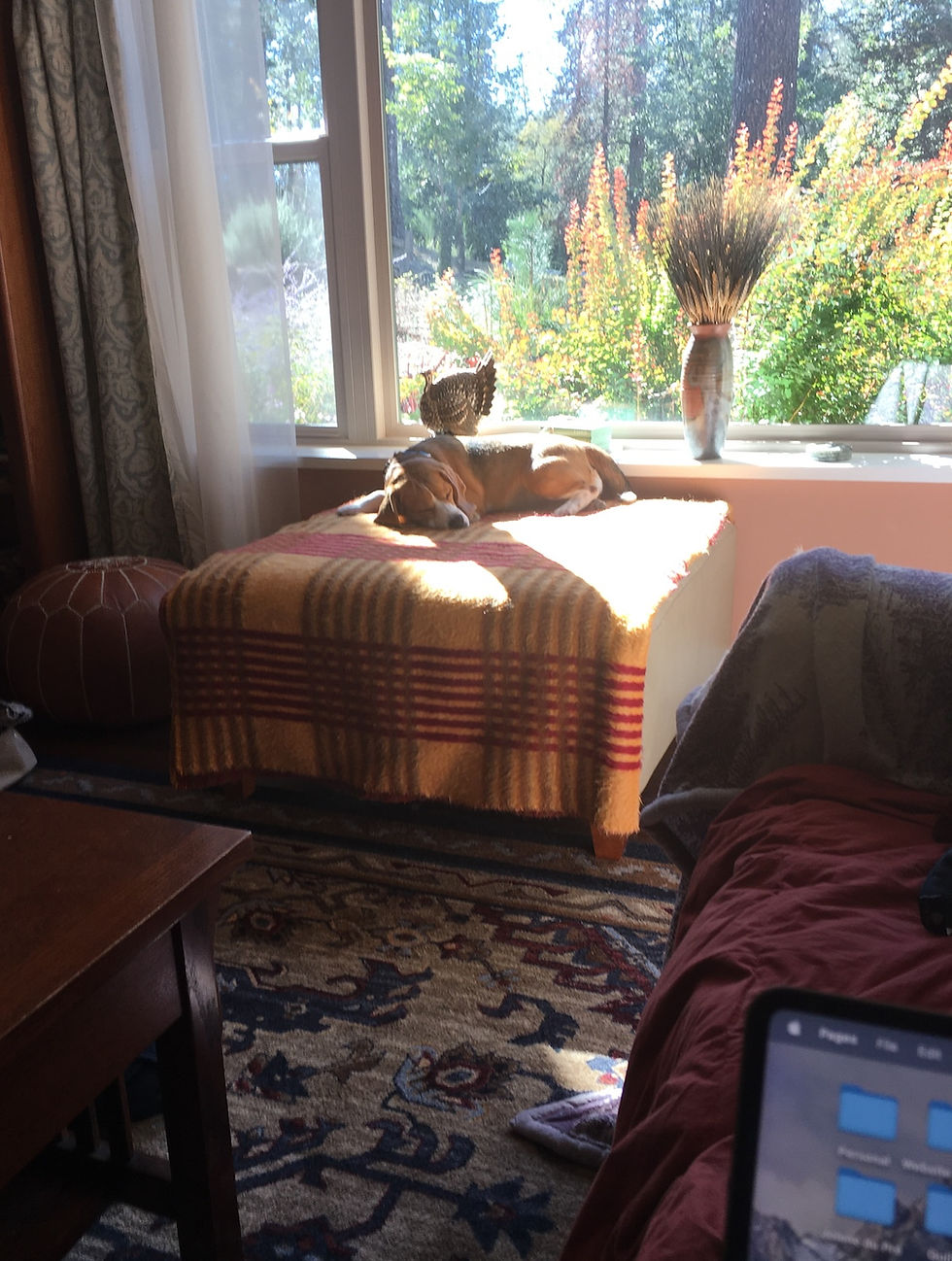
Jolene is of a similar mind, or instinct.
At present, she has yielded to slumber, after having fought it for at least five minutes. Me, I’m more of a contender/prize-fighter when it comes to resisting yielding to the inevitable. I fight the unavoidable, not to delay it, or deny it, but to get myself ready to confront it, be it a celebration or a grievous sorrow.
Oftentimes, my steely persistance in girding my loins has been mistaken, by carpers, for procrastination, or laziness, even weakness. That presumption has always been a stupid mistake on the part of my adversary. I fortunately learned, early in life, to allow such an error to work to my advantage.
As the great Napoléon Buonaparte (15 August 1769 - 5 May 1821) has so often been quoted as having said (without definitive proof that those words were ever uttered by the little Corsican):
« Lorsque l’ennemi fait un mouvement, il faut se garder de l’interrompre ».
The inelegant English version is: “Don’t interrupt your enemy when he is making a mistake.”

Napoléon was very much a verbal guy. He didn’t write down any of his war strategy, battle plans, or military theory. He never mastered the French language. In fact, he spoke la langue atrociously, which may have had something to do with his aversion to penning his military genius. He also seemed to have had an aversion to trusting people, and one can hardly blame Bonaparte for that defense mechanism!
The afore-cited quotation is culled from the biography of Napoléon, Vie Politique de militaire de Napoléon, written by Baron Jomini and published in 1827, approximately six years after the death of Napoléon on the island of St. Helena, in the South Atlantic Ocean.

The Emperor of the French had been enduring his second exile, from 1815-1821, his first exile having been spent on the isle of Elba, in the Mediterranean Sea, from 1814-1815.
Without the life and death, the battles and the losses, the victories and the failures, the glory and the ignominy, the exile and the re-entry, the final exile and the conspiracy-theory-laden death of this revered, reviled, respected, resented, worshiped, loathed, loved, exploited and emulated Emperor of the French, the world would not be as it is today.
The nation of France was altered in ways that are still not completely understood, even by the French (or especially by the French), due to the outcomes and influences — intended, accidental and totally unexpected — of one of the greatest military commanders in human history.
He was, at the same time, a vain vicious despot, and not really a Frenchman. His father’s lineage was Tuscan, of nobility; his mother’s ancestors were descended from nobility in Lombardy. The historic fact that Buonaparte captured the imagination, the spirit, the identity and the fashion flair of an entire nation, along with a vast swath of Frenchmen who fought in what would become known as the Napoleonic Wars, therein resides a tale that continues to be told, again and again and again, in fiction and in fact.
The world needs heroes, great men and great women, who rise to the occasion, for the most noble of reasons. The fact that we, in America, and other freedom-loving peoples throughout the world, have endured, during at least the past several decades, anti-heroes, posing as saviours, that ugly fact does not warrant the cynical aspiration to valor that the parasitic cynics need, the way a vampire craves blood.
We need heroes more than ever BECAUSE of the coward’s blood-lust to destroy, defame, and annihilate any and all champions, conquerors, white knights, warriors and winners.
The wusses of the world do not outnumber the fearless and the plucky. They covertly, and brazenly, blackmail, blackball and blackguard their way to power, until they are found out. Tis then that the crumbling of their extortion-empires begins.
I’ll wager the great Napoléon knew those inescapable truths of life, in Corsica, in France, in Elba, in Saint-Helena, in perpetuity.


